


For more than twenty years, the blue link has been the defining symbol of search.
Search meant typing keywords into a box, scanning a ranked list of pages, and clicking through results one by one. The entire internet economy—from publishing to advertising—was built on this interaction model.
What is happening now is not an incremental update to that system. It is a structural departure.
AI-powered search is not abandoning blue links by accident. It is doing so because the underlying purpose of search has changed.
Search Has Always Been About Reducing Effort
At its core, search has never been about links. It has been about effort reduction.
Early search engines reduced the effort of finding information across a fragmented web. Blue links were the best interface available at the time: they pointed users in the right direction and allowed them to explore on their own.
But blue links also assumed something fundamental—that users were willing to do the work of comparison, synthesis, and decision-making themselves.
That assumption no longer holds.
Today’s users do not want ten possible answers. They want one usable answer. They do not want to browse. They want to resolve.
AI search is a direct response to this shift in user behavior.
From Navigation to Resolution
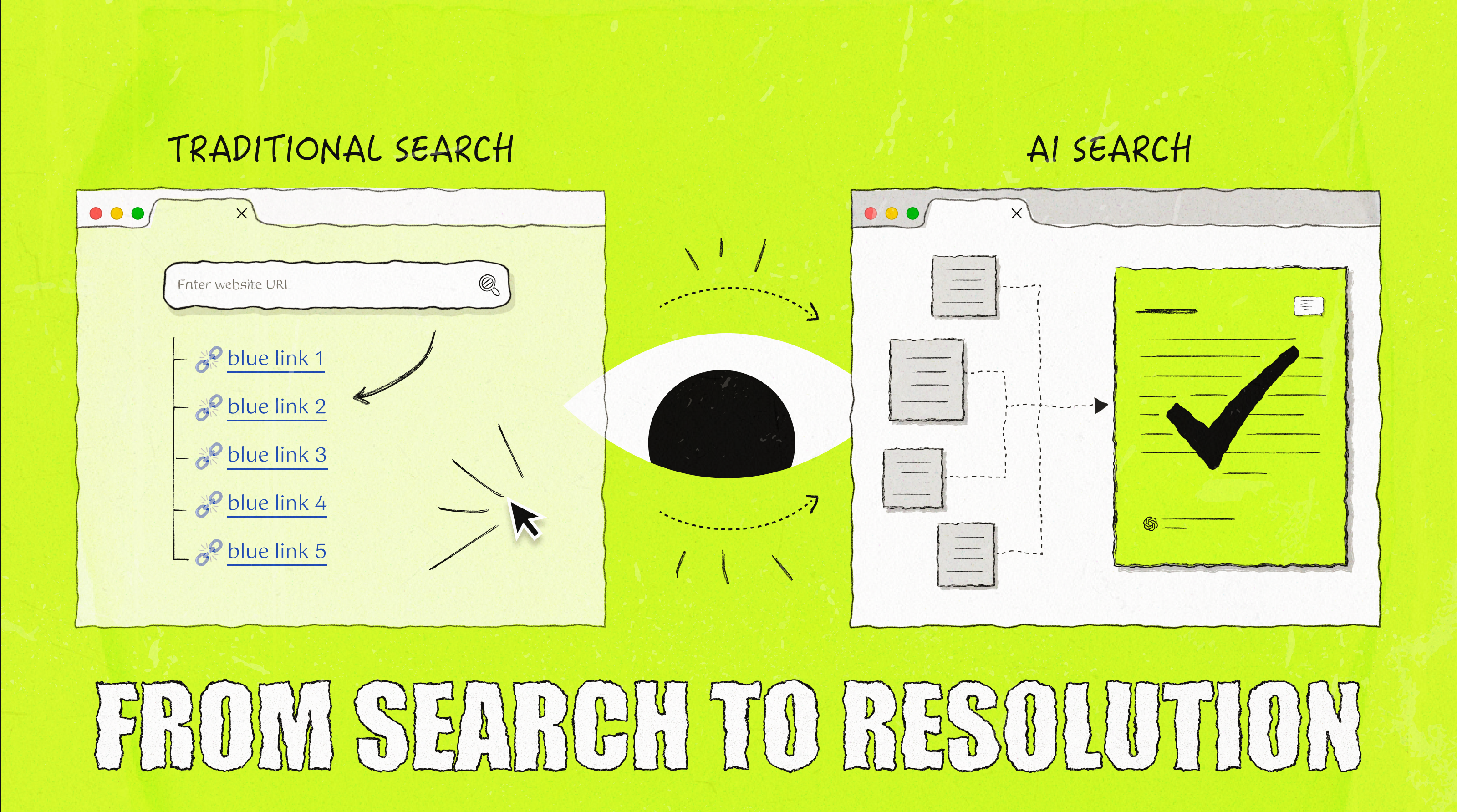
Traditional search engines act as navigational tools. They help users find places where answers might exist.
AI search systems act as resolution tools. They attempt to produce the answer directly.
This change alters what the search system optimizes for.
Instead of ranking pages based on relevance signals, AI systems interpret intent, evaluate information across sources, and synthesize conclusions. The goal is no longer to send users elsewhere, but to complete the task within the interface itself.
Blue links are not removed because they are outdated. They are removed because they introduce friction in a context where users increasingly expect immediacy.
The Decline of Choice as a Feature
In the blue-link era, choice was considered a benefit. More results implied more control.
In AI search, choice becomes cognitive overhead.
When users ask a question in natural language, they are implicitly delegating judgment to the system. They expect the AI to filter, weigh, and decide on their behalf. Presenting multiple links in this context feels like unfinished work.
This is why AI search favors answers over options.
The interface reflects a deeper contract: the system is no longer a directory. It is a decision-support layer.
What Replaces Blue Links
The disappearance of blue links does not mean that sources are irrelevant. It means they are abstracted.
AI systems still rely on underlying information, but that information is transformed into structured explanations, summaries, and recommendations. Sources are consumed by the system rather than evaluated by the user.
In this model, visibility shifts away from surface-level placement toward internal selection. Being “findable” matters less than being usable.
Content that is unclear, redundant, or poorly structured may exist online, but it is unlikely to survive the synthesis process.
A Behavioral Shift, Not a Design Choice
It is tempting to view the removal of blue links as a design trend. In reality, it is a response to how people now interact with information.
Users increasingly treat AI as an interface for thinking, not just searching. They ask follow-up questions, refine intent mid-conversation, and expect continuity across queries.
Blue links were designed for isolated queries. AI answers are designed for ongoing reasoning.
Once search becomes conversational, returning a list of static links no longer makes sense.
Implications for Content and Discovery
For content creators and brands, the disappearance of blue links signals a deeper challenge.
Visibility is no longer earned by occupying space on a results page. It is earned by contributing meaningfully to the answers users receive. Content must now survive interpretation, not just indexing.
This shift changes how authority is established, how trust is formed, and how influence is measured.
Being present in AI-generated answers means shaping understanding at the moment it matters—before a user ever considers visiting a website.
Looking Forward
Blue links are not gone everywhere, and they may not disappear entirely. But their role as the primary interface for discovery is fading.
AI search reflects a broader evolution: from exploration to resolution, from navigation to understanding, from choice to synthesis.
Understanding this shift is the first step toward adapting to it.